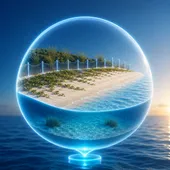
Beach and dune restoration for Mauritian coastlines
Mauritius's beaches lose sand every year — reef decline, storm events and development pressure combine to undermine hotel frontages, residential shoreline and public beach infrastructure. Restoring a beach starts with understanding why it's eroding, not with simply replacing what's been lost.
What we deliver
We profile the beach and characterise its sediment — grain size, composition and transport direction — before proposing a fix. Depending on what the data shows, a restoration design may include dune reconstruction, vegetation stabilisation to hold the rebuilt dune in place, and nourishment sized and shaped to match the site's specific wave and sediment regime.
Nature-based vs hard armour
Hard armour — seawalls, rock revetments — can stop erosion at one point while accelerating it next door, and tends to remove the beach itself over time. Where site conditions allow, we favour nature-based approaches: rebuilding the beach and dune system to absorb wave energy the way an intact reef and healthy sediment budget naturally would. Hard armour still has a place on high-energy or heavily constrained sites — the right approach depends on the site's wave climate, sediment supply and what's already been built. Read more inHard armour vs nature-based coastal protection.
Our methodology
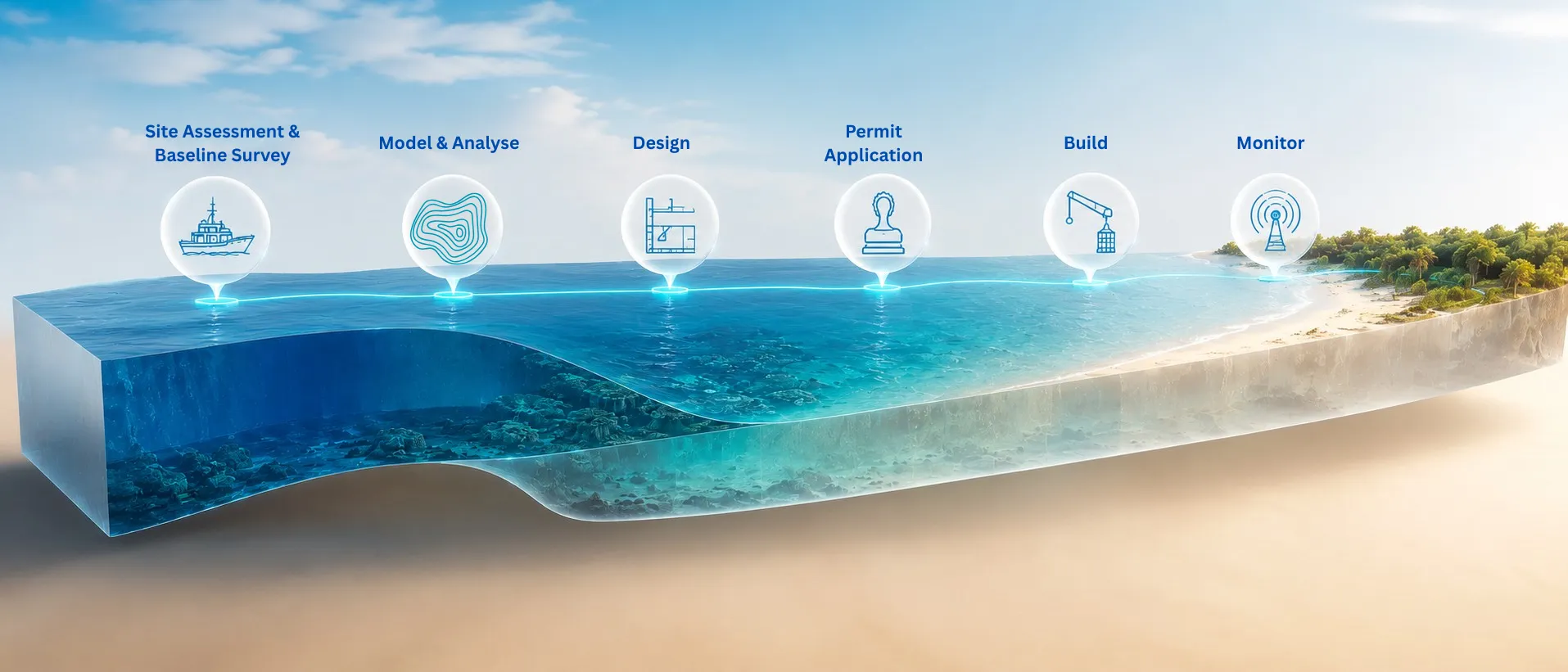
Investigate
Beach profiling and sediment/grain-size characterisation to establish the site's erosion baseline.
Model
Wave and sediment-transport modelling to understand how sand moves at this site and predict restoration performance.
Design
Dune reconstruction, vegetation stabilisation and nourishment design, sized to the site's wave and sediment regime.
Permit
EIA/PER permitting support for the proposed restoration works.
Build
On-site nourishment, dune reconstruction and vegetation stabilisation works.
Monitor
Post-deployment beach-profile monitoring to track performance and inform any follow-up nourishment.
Delivered work
Bois des Amourettes Beach Nourishment & Stabilisation
Served as wave and coastal hydrodynamics modeller for the nourishment design, modelling the long-term evolution of the nourished beach profile to validate design longevity. Also maintained the ocean data well and managed ongoing data retrieval.
Led by OceanVolts' Managing Director, Nissar Sumodhee, prior to founding the firm.
Grand Sable Beach Nourishment & Stabilisation
Served as wave and coastal hydrodynamics modeller for the artificial beach design, contributing to both design and construction. Modelled long-term nourished-beach evolution to validate the design against the site's wave climate.
Led by OceanVolts' Managing Director, Nissar Sumodhee, prior to founding the firm.
Natural Beach Restoration, Private Villa — Poste Lafayette
Manually sand-nourished and restored a 35 m escarped beach frontage using soft-engineering methods — sand bags and site-specific coastal plants — to rebuild berms and consolidate the dune toe. A 12-month post-implementation maintenance programme secures long-term sustainability.
See how this service was applied in a live project:Beach Frontage Cleaning & Hazard Removal, Les Salines.
Outcomes
A well-designed restoration rebuilds beach width and dune resilience matched to the site's actual wave and sediment conditions — not a generic template. We size every design so its performance can be tracked against the baseline data gathered during the survey, and provide monitoring data to support permit conditions and future maintenance planning. Read more on ourNumerical Wave Modelling service, which underpins every restoration design.
Frequently asked questions
How long does beach restoration take?
Timelines depend on project scale, permitting requirements and weather windows. Survey and design typically take several weeks; on-site nourishment and dune works are scheduled around calm-season conditions and confirmed once permitting is in place.
Is beach nourishment permanent?
No restoration is truly permanent — sand naturally moves. A design matched to the site's sediment characteristics and wave climate is built to last, and its lifespan can be extended with complementary measures like dune stabilisation or sand retention structures.
Do I need an EIA for beach restoration in Mauritius?
Most works that modify the shoreline or foreshore require either an Environmental Impact Assessment (EIA) or a Preliminary Environmental Report (PER), depending on scale and location. Our EIA & PER Permitting service scopes which applies to your site.
What causes beach erosion in Mauritius?
A mix of natural and human factors: reef decline that reduces natural wave protection, reduced sediment supply, sea-level rise, and storm or cyclone events — compounded by coastal construction and development pressure. The relative weight of each driver is site-specific, which is why every restoration project starts with a survey.
Further reading: Why Mauritius beaches are eroding· Beach nourishment in Mauritius
Losing sand at your site?
Start with a survey — we'll characterise the problem before proposing a fix.
Request a Coastal Survey →