
Coastal environmental monitoring
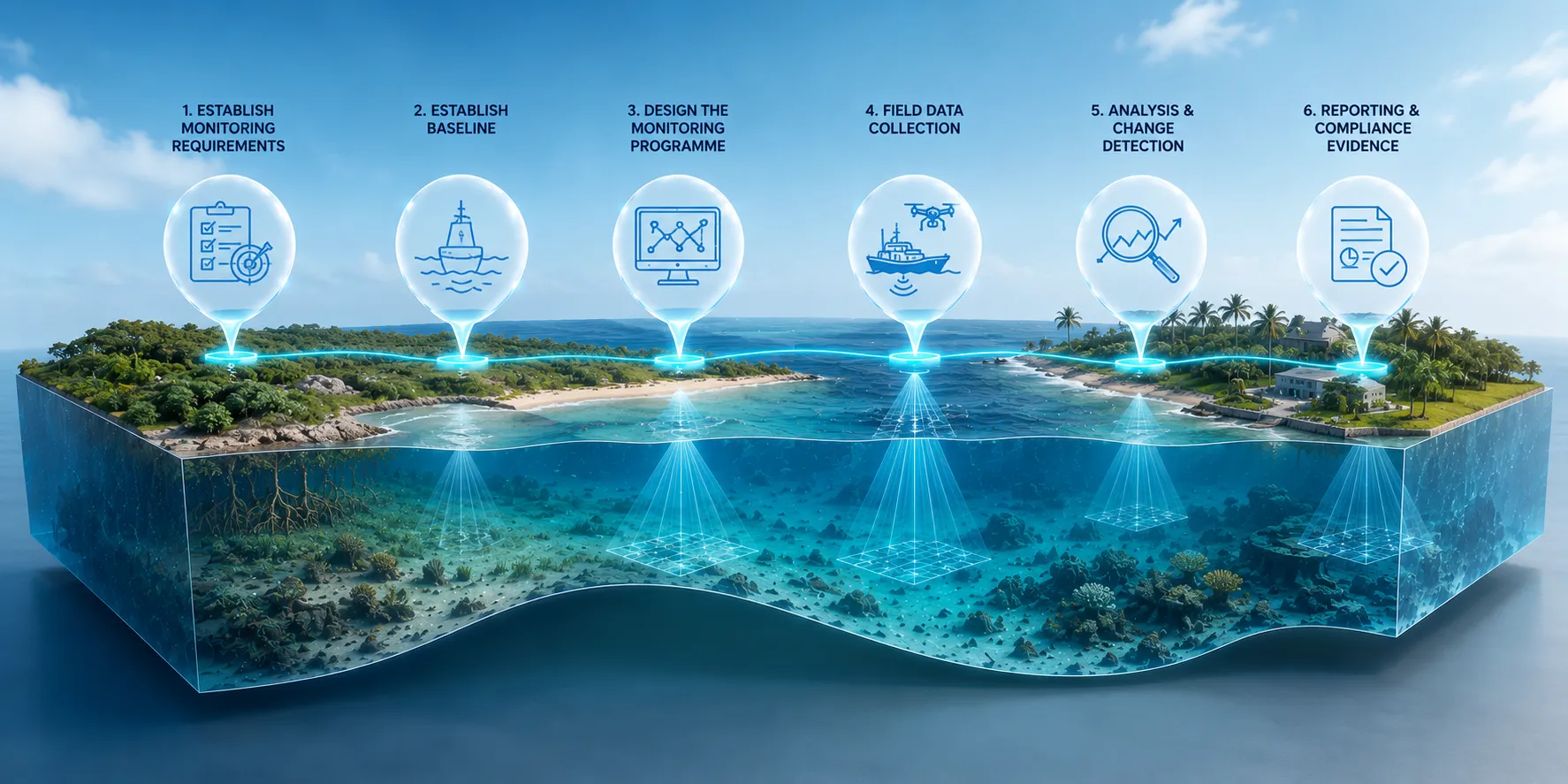
Monitoring is how outcomes get proven and permit conditions get satisfied — the evidence layer behind every coastal project, not just a survey done once and filed away.
What we deliver
We deliver water-quality monitoring, reef and benthic health surveys, beach-profile tracking, and post-construction compliance reporting — the ongoing evidence layer behind every coastal project.
Why monitoring matters
Monitoring is how permit conditions get satisfied and outcomes get proven — it detects change over time and gives clients and authorities defensible evidence, rather than a one-off snapshot. Read more on our EIA & PER Permitting service, where monitoring often forms part of the permit conditions.
Our methodology
Investigate
Baseline data collection — the first monitoring dataset a site is measured against.
Model
Where required, monitoring data feeds into change-detection and trend analysis.
Design
Monitoring parameters and frequency designed around what the project or permit needs to demonstrate.
Permit
Monitoring commitments built into the EIA/PER application as a permit condition.
Build
Monitoring continues through construction to track any impact of the works themselves.
Monitor
Ongoing post-deployment monitoring, with periodic reporting against baseline.
Delivered work
Pointe d'Esny Coastal Monitoring
Monitored beach profiles along 5 km of coastline under erosion stress, measuring and assessing beach-profile evolution over the monitoring period.
Led by OceanVolts' Managing Director, Nissar Sumodhee, prior to founding the firm.
Trou aux Biches Beach-Profile Monitoring
Monitored beach profiles along a rock-revetment coastal erosion defense structure over time, tracking how the shoreline responded to the installed defense works.
Led by OceanVolts' Managing Director, Nissar Sumodhee, prior to founding the firm.
Ulva Lactuca Algae Culture — Open-Sea Demonstration
Built and deployed a 36 m² floating raft and culture-line system for Ulva Lactuca cultivation, then maintained and monitored the culture to demonstrate technical feasibility and deliver capacity-building to the local community.
See how this service was applied in a live project:Grand Sable Beach Nourishment & Stabilisation — EIA.
Outcomes
Regular monitoring turns a one-off claim into a defensible track record — data that supports compliance reporting, informs maintenance decisions, and can feed into a futurecase study once enough data has been gathered. See also ourCoastal & Marine Surveys service, which establishes the baseline every monitoring programme is measured against.
Frequently asked questions
What is coastal environmental monitoring?
Coastal environmental monitoring is the ongoing measurement of water quality, reef or benthic health, and beach-profile change at a site — used to detect change over time, satisfy permit conditions, and provide evidence that a project's environmental commitments are being met.
How often should coastal monitoring happen?
Frequency depends on what's being tracked and what a permit condition specifies — some parameters need frequent short-interval readings, others are meaningful on a longer cycle. We scope the monitoring frequency to the specific site and permit requirement rather than applying a fixed schedule.
Is monitoring required after an EIA?
Often, yes — many EIA and PER approvals in Mauritius carry monitoring conditions as part of the permit. Our EIA & PER Permitting service scopes what monitoring commitment applies to your specific approval.
Need to prove an outcome or satisfy a permit condition?
We'll scope a monitoring programme matched to what your site and permit actually require.
Request a Coastal Survey →