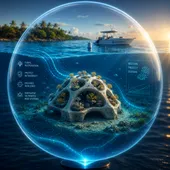
Coral reef restoration
Reef decline threatens more than marine life — a healthy reef is a natural breakwater, and its loss accelerates beach erosion behind it. Restoring reef health is both an ecological and a coastal-protection intervention. Read more inCoral reef decline in the Indian Ocean.
What we deliver
We deliver reef health assessment, coral propagation and transplantation, and substrate and structure design — see our Erosion Control & Sand Retention Systems service for the engineered side of reef structures — and ongoing monitoring to track restoration success.
Why reef health protects coastlines
A healthy reef breaks up incoming wave energy before it reaches the shore — the same function an engineered breakwater performs. As reefs decline, that natural protection is lost, and the beaches behind them erode faster. Restoring reef health is often the most cost-effective long-term coastal protection available.
Our methodology
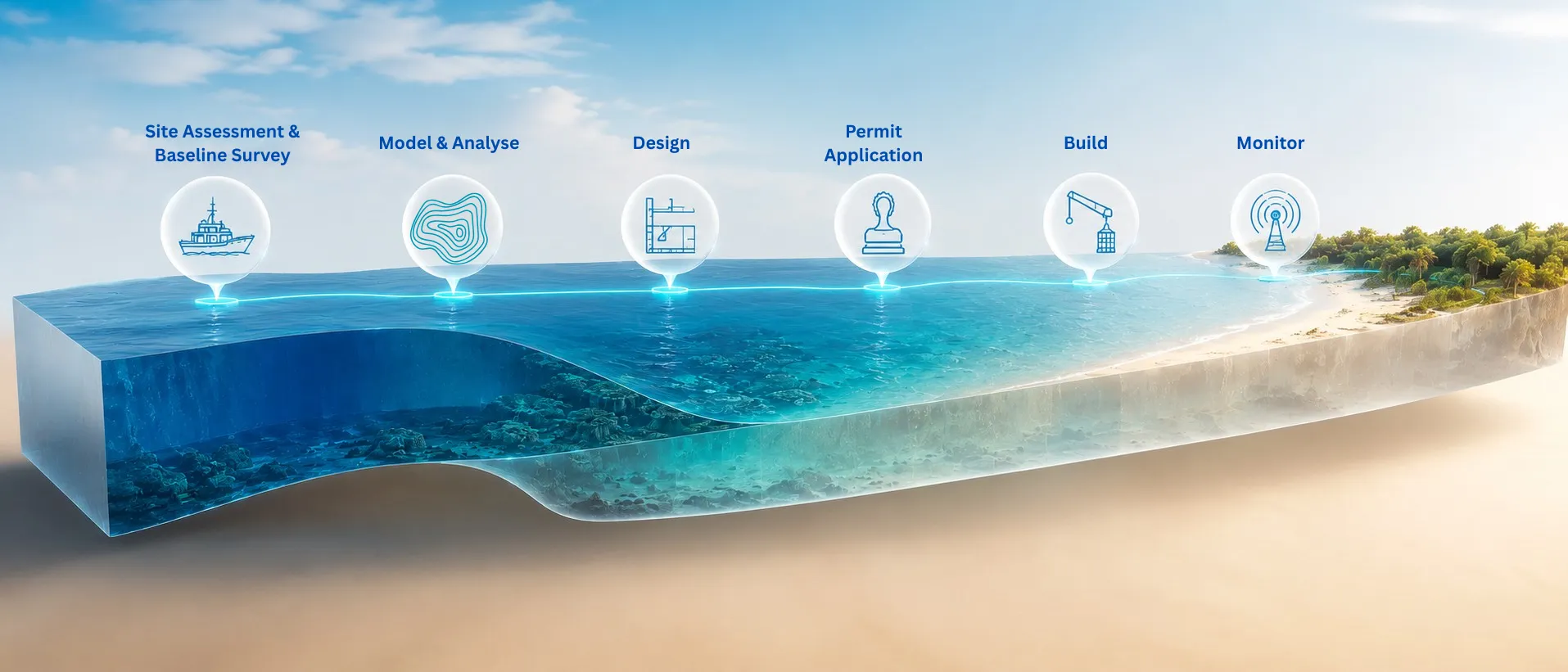
Investigate
Reef health assessment — benthic and biological survey to establish baseline condition.
Model
Assessment of the reef's wave-dissipation contribution and what's lost as it declines.
Design
Coral propagation, transplantation and substrate/structure design matched to the site.
Permit
EIA/PER permitting support for the proposed restoration works.
Build
On-site coral propagation, transplantation and structure deployment.
Monitor
Ongoing monitoring to track coral survival and reef recovery.
Delivered work
Seabased Coral Farm Development, Rivière Noire
Built and deployed 20 × 1 m² coral culture tables, collecting and nurturing lagoon-sourced Coral of Opportunity. Reintroduced 2,000 fragments across multiple lagoon coral species back into the Île aux Bénitiers Lagoon.
Marine Memorial Project, Île aux Bénitiers Lagoon
Conducted a biological survey of the proposed Marine Memorial Ground to assess benthic and fisheries (halieutic) life, informing the ecological design of the engineered reef structures deployed on the site.
See how this service was applied in a live project:Marine Memorial Project, Île aux Bénitiers Lagoon.
Outcomes
Reef restoration outcomes are measured in survival rate and coverage over time, not just fragments planted — we monitor what's deployed to confirm it's actually taking hold. Read more on ourEnvironmental Monitoring service, which tracks restoration performance over time.
Frequently asked questions
Can damaged coral reefs be restored?
Yes, within limits — coral propagation and transplantation can accelerate recovery of a damaged reef, particularly where the underlying cause of decline (poor water quality, physical damage, warming) is also addressed. Restoration works best as part of a broader reef-health strategy, not a standalone fix.
How does coral restoration work?
Coral of Opportunity — live fragments already broken loose, often by storm damage — is collected and nurtured on culture tables until it's established, then reintroduced to the reef or a designed substrate. It's a lower-impact approach than harvesting from healthy colonies.
Why are Indian Ocean reefs declining?
Reef decline in the Indian Ocean is driven by a mix of warming-driven bleaching events, physical damage, and water-quality pressure from coastal development — the same drivers behind Mauritius's own reef decline.
Reef declining at your site?
Start with a survey — we'll assess the reef's condition before proposing a restoration plan.
Request a Coastal Survey →